Congress establishes the Refugee Tract across Franklin and Fairfield counties; pioneer families, including the Woodmansees, settle the area by 1818.

Long before Eastland became a regional destination, the ground beneath it carried a different name: the Refugee Tract. In the wake of the American Revolution, Congress set aside over 100,000 acres of Ohio countryside - stretching east from the Scioto River through what is now Franklin and Fairfield counties - for Canadian refugees who had risked everything to support the colonial cause. The Ohio Statehouse itself stands on this same historic grant. By 1818, pioneer families like the Woodmansees had put down roots in the area. Dr. Ray D. Woodmansee, a Columbus osteopath, later cultivated a different kind of refuge: Catalpa Park. Four miles east of downtown, 25,000 catalpa trees formed a leafy sanctuary along Hamilton Road - a recreation area where residents sought shade and rowed boats until the park was subdivided for housing in 1925. The land has always been a place of refuge, recreation, and renewal.
For much of the late 20th century, Eastland was one of Columbus's most vibrant commercial and residential corridors. Anchored by the Eastland Mall - one of the region's premier shopping destinations - the area drew visitors, supported hundreds of local businesses, and provided a strong economic foundation for the surrounding community.
Families put down roots here. Businesses thrived. The 43232 corridor buzzed with activity, commerce, and community life. Eastland wasn't just a place people passed through - it was a place people called home.
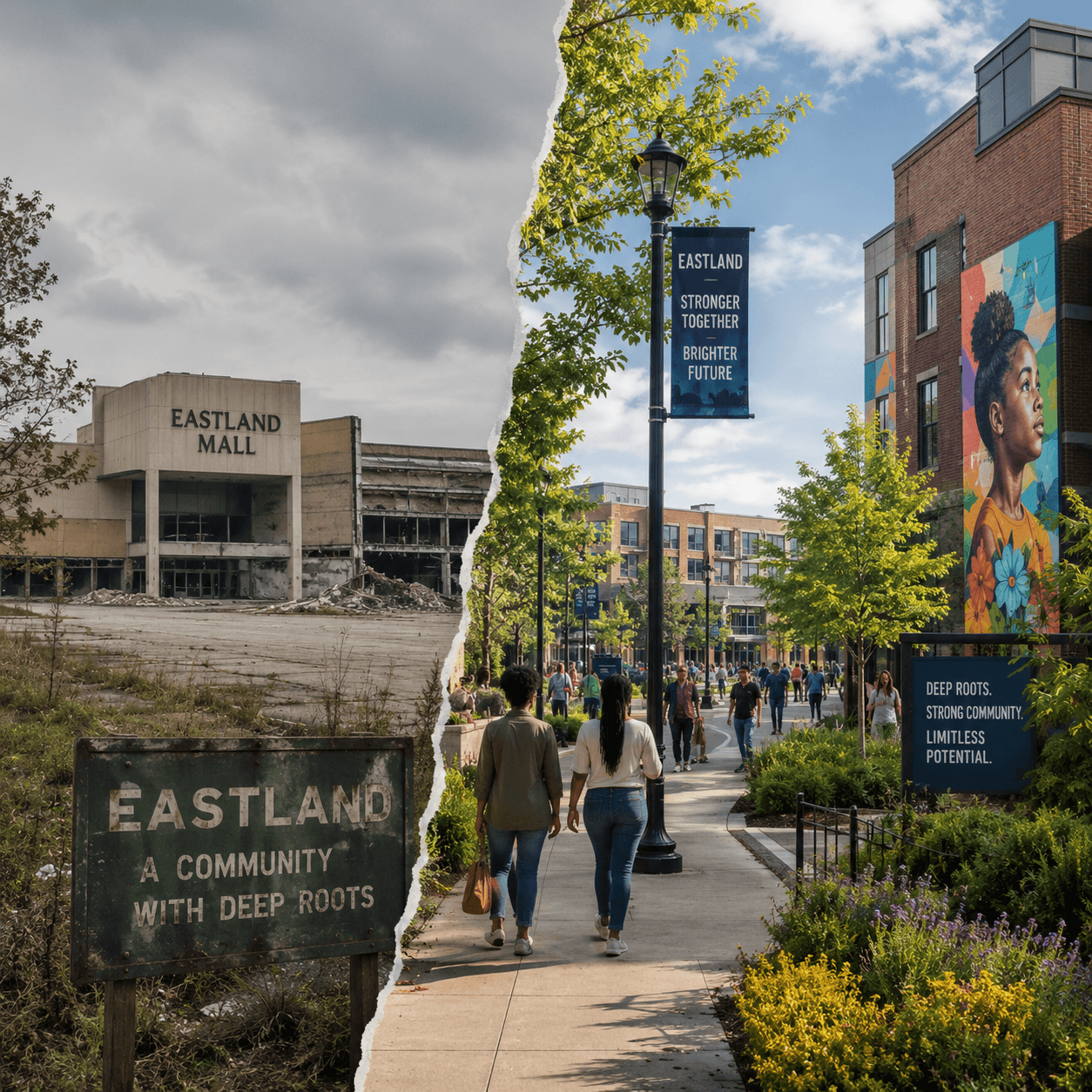
Like many urban communities across the country, Eastland faced a period of significant economic and infrastructural decline. The closure and eventual demolition of the Eastland Mall marked a symbolic turning point - the loss of a major anchor that had driven foot traffic, employment, and community identity for decades.
Today, the area contends with job loss, aging infrastructure, limited pedestrian connectivity, and a shortage of major anchor institutions. Retail vacancies, reduced investment, and mobility challenges have made it harder for residents to access opportunities - and harder for businesses to thrive.
Eastland offers strong opportunities for growth - including retail demand, proximity to major employment centers, and active community organizations.
E.D.G.E., Inc.
But challenges don't tell the whole story. Eastland is also a community of tremendous resilience, deep roots, and emerging momentum.
Congress establishes the Refugee Tract across Franklin and Fairfield counties; pioneer families, including the Woodmansees, settle the area by 1818.
Dr. Ray D. Woodmansee's Catalpa Park - a 25,000-tree recreation area four miles east of Columbus - is subdivided for housing as the region grows.
Eastland Mall opens, establishing the corridor as a regional commercial hub
Eastland area at peak — thriving retail, growing residential communities
Economic shifts begin; anchor retailers reduce presence
Continued decline; infrastructure challenges mount; community calls for action
"Eastland for Everyone" plan launched — nearly 2,000 community voices shape a bold revitalization blueprint with 8 Big Ideas
State of Ohio awards funds for Eastland Mall demolition and site cleanup; Eastland Prosperity Center development begins on former Kroger site
Hamilton Rising redevelopment project advances — transforming a shuttered hotel into 300+ mixed-use residential units
E.D.G.E., Inc. incorporated and activated as the community's dedicated economic development engine
8 Big Ideas
In 2023, the City of Columbus Department of Neighborhoods — working alongside residents, planners, and development strategists — launched the "Eastland for Everyone" plan. Built from nearly two thousand community voices, the plan establishes eight Big Ideas and a comprehensive implementation framework to guide Eastland's revitalization for years to come.
E.D.G.E., Inc. operates in direct alignment with this plan — serving as a key on-the-ground partner in turning that vision into action.
E.D.G.E., Inc. was founded precisely because Eastland's revitalization requires a dedicated, community-rooted organization to drive it. We're not a government agency, and we're not a developer with outside interests. We're a nonprofit anchored in this community, accountable to this community, and working every day to move it forward.
Through strategic economic development, infrastructure advocacy, and deep community engagement, E.D.G.E. is helping Eastland reclaim its identity - and build something even better than what came before.